Monday, January 23, 2012

Oatmeal

Oatmeal??  Yes.  I'm sure you are wondering what oatmeal could possibly have to do with ANYTHING that this blog touches on.  Well, I'll get to that...

When oatmeal comes to mind, I'm sure most of you think: "crappy breakfast" .  Well, oats are a grain, and grain is what you use to make beer.  Although beer is mostly made of malted wheat and barley, small amounts of oats can be added to a beer recipe to impart some excellent additions to a beer.

I am currently in the process of brewing an oatmeal stout, in fact, I just bottled it several days ago and it should be ready to drink very soon.  An oatmeal stout is a very similar to other stouts (Guinness beer is a stout, for instance), except that adding oatmeal increases the body, viscosity and silkiness of the beer.  There was an article posted in "Brew Your Own" magazine that describes it this way:
"Typically, oatmeal stouts do not specifically taste of oats. However, the oats impart the well-known smoothness because of their high content of proteins, lipids (includes fats and waxes), and gums. The gums increase the viscosity and body of the beer."
To put it in slightly less technical terms:  Oatmeal has tiny particles of awesome contained within the grain, these bits of awesome are transferred to the beer during the brewing process, oatmeal's awesome particles are infused with the already sizable awesome particles contained within the beer, adding to the overall awesomeness of the beer.

So when I decided to create an oatmeal stout, I figured I would do some research on the beer to hopefully pick up some tips to help me out a bit.  Within minutes of researching, I found probably the best advice possible.  It instructed:

"In a sublime stout, you need to create an effective interplay between the robust immediateness of the roasted, acrid malts and the floral-aromatic reverberations of the hops."
Uh..  Right, got it.  So this is going to be easier than I thought!!   As instructed, this was the first step that I performed when I started making my beer... you're just going to have to trust me on this one.   I guess we'll just have to wait and see if I was successful in creating the "effective interplay".   I'm guessing this is going to take awhile for all the ingredients to get to know each other well enough to commence in interplay...

Hopefully this will give you guys something a little more enlightening to imagine when you hear the word "oatmeal".


Summary for the Skimmers:   Oatmeal has the lipids.  There's no known cure... but it certainly makes for good beer!

Saturday, January 14, 2012

Cocktail Robots

A cocktail robot is exactly what you would expect it to be:  an automated device that can mix drinks for you on command.  And believe it or not, my final project for my senior microcontroller class in college was a cocktail robot.  The project was a complete disaster!  In hindsight, it's very possible that more time was spent sampling the product than working on the project.  The final demonstration didn't go well at all. In fact, whenever you exclaim "Oh Sh*t!" during a recorded final demonstration, things aren't going very well...at all.  However, for some reason, the professor generously gave us a passing grade. 

Anyway, I was reminded of this project when I came across an online story of a similar project (although considerably more creative... and working).  Apparently, there is quite a community out there that builds these types of projects.  In fact, there are several annual competitions to demonstrate your robotic (and possibly drinking) chops.

So anyway, you absolutely need to check out the cocktail robot that was created by the folks over at Evil Mad Scientist Laboratories.  Pay close attention to the devices they used to pump the ingredients!  Funny!  The fact that they are making white russians with the robot makes it even better!


Here is the link to the original article, complete with more pictures as well as a video.

"White Russian? Coming right up, heavy on the irony!"


Thursday, January 12, 2012

Happy New Year!

Happy 2012 to all!

The holidays were a whirlwind, good times were had by all, but unfortunately, I'm pretty sure that good times are inversely proportional to progress.  Or, if you don't mind me going all geek on you:


I have high hopes for this year with many great things planned and high expectations!  I plan on completing my thermostat for my fermentation chamber fairly early in the year. If all goes well with the thermostat, I will move forward with getting this device available for other home brewers to use. However, lots of work has to be completed for that to happen.   Plus I have to overachieve a little this year in case the Mayans were right (er.. got lucky).


Here's to a good year!!

Thursday, December 8, 2011

Prototypical Stuff

Hola!

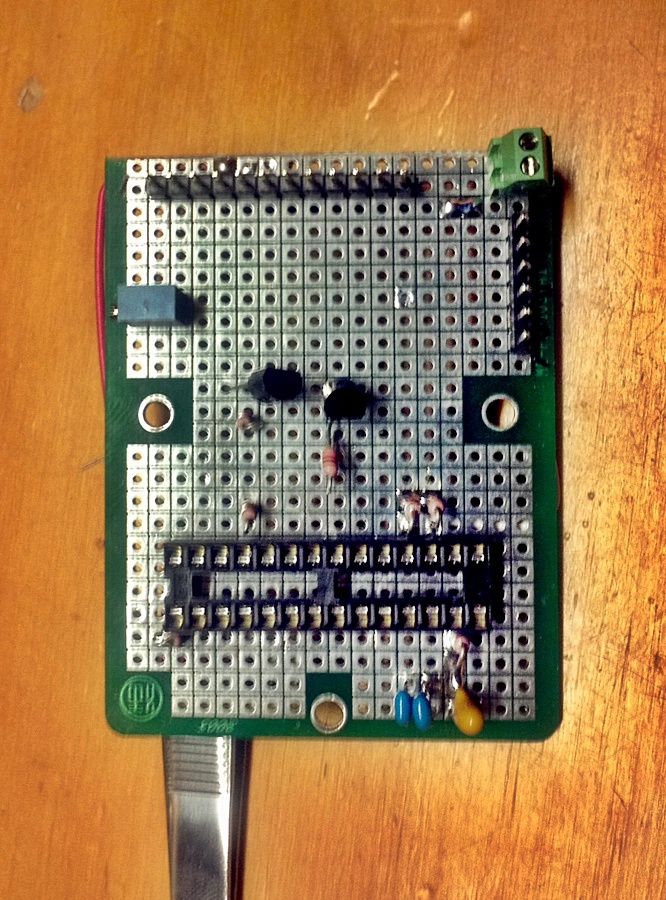
So I'm actually to a point on this thermostat that I'm ready to actually start building the PC board that contains controller and accompanying components (the smarts of the innards).  I've actually spent a few hours placing, soldering and wiring the parts on the prototype board.  This is tedious work to say the least, you are working with tiny parts and a soldering iron (which is essentially a pen shaped, skin searing device that rests at 700 degrees F).  Burned skin, strained eyes and fingers are consistently a by-product of this process.

Here is a front/back pic of the progress I've made so far; I'm at about 40% complete:


So at this point in the soldering process, already sick of it and looking for alternatives, I visited a few PCB (Printed Circuit Board) websites and found an awesome (fairly) new website and service setup for people making prototype PCBs.(Hey wait, I'm a people wanting to make protoype PCBs)  Making PCBs aren't very expensive, as long as you are getting hundreds of them made at a time, to make small one, it's quite expensive. 
The service that I found essentially takes dozens of submissions for boards from multiple customers and places them together like a puzzle on one big board.  Then it sends this large, completed puzzle off to get it printed.  When it gets this large board, it slices up all the pieces to distribute to everyone.  This way, the price is divided up among the dozens of people building boards.  BRILLIANT!!

So for about $15 I can design my own PCB and have it printed for me.  Screw all this start-from-scratch fabrication crap!  The downside is that there is a 3 week delay before I get the board back, but that's acceptable.

So, the last couple night's I downloaded the software used to design and route the board, read a few tutorials and got to work.  Within a few short hours, I'm almost ready to send off my first PCB!  Sweetness!! 

Here's a screenshot of the layout of the PCB:


I'll keep you posted when this baby shows up.  Stay tuned!

Sunday, December 4, 2011

Parts is parts

OK, so I've given you an inkling of what the thermostat is supposed to do and what it may or may not look like (if you're not up to speed, check out some of my earlier posts.)  I'm just SURE you guys are out there wondering, "What sort of black magic makes this thingy work??" Well, this magician is here to reveal his secrets...  (about the thermostat... don't get greedy.)

Well, the brains of this operation comes from a microcontroller, more specifically a PIC18F microcontroller.  Essentially, it's a small processor, think of an Intel Processor from a computer, circa 1985. However, if the Intel 8086 processor is your average pocket knife (it isn't), the PIC is a super utility Swiss Army knife (still an analogy folks, please don't try to open a can of ravioli with this.)  The 'micro' in microcontroller only refers to the size of the device, functionally, it should probably be referred to as a macrocontroller... or possibly a ginormo-controller.

The microcontroller (or ginormo-controller, if you prefer) keeps track of everything within the thermostat.  It reads the temperature of the thermocouple (a device that converts temperature to a voltage for the PIC to read), it controls the relay (an electrically controlled switch) that turns on and off the electricity to the freezer, it reads the inputs from the push buttons on the front panel, keeps track of time, stores the heating and cooling program sequences, and most ostensibly, controls the LCD screen on the front panel. And YES, it will indeed open up a can of ravioli, but only once, and other tools are probably required...

Much like the processor that's in your computer, the microcontroller runs a program.  To the microcontroller, this is just a list of binary numbers that are interpreted as instructions, it reads each instruction, one at a time, completes the instruction, then goes to the next instruction in the list.  To us, this same program is a list of instructions written in a programming language, in my case, the c programming language, which is a universal and very versatile programming language that has been around for a long time (it was developed in the early 70s).

Once I write the program using my desktop PC, I have to run it through a software program that compiles the c program into binary for the controller to understand and interpret. The binary program is then loaded and stored on some flash memory (same flash memory that's in a USB memory stick) embedded within the controller (did I tell you how cool this thing is??).   Once loaded and running, my particular program runs a repetitive loop that, essentially, reads the current temperature, updates the time, updates the relay outputs in response to the new temperature, then performs any screen updates if necessary.  Of course it goes into a different section of the program to create the user interface, menus and setup pages, but the majority of the time, the microcontroller is in a repetitive loop, repeating the same things over and over again.  Which is something I'm sure we can all relate to from time to time...


Summary for the skimmers:  Microcontrollers are very versatile, very useful and impressive, but a poor choice for a survival tool.


**Disclaimer:  I apologize for any extra geekiness that may have slipped out during this post...  I usually do my best to conceal that as much as possible.

Tuesday, November 29, 2011

Happy Belated Thanksgiving

Happy Thanksgiving everyone! 

I apologize for the lack of posts lately.  It seems that life has been going on behind the scenes here.  However, for that, I am very thankful!

I've got a post in the works that I plan to get out very soon and hope to have a few more posts despite the fury of the holiday season being upon us.

I hope your Thanksgiving weekend was full of excessive amounts of fowl-ness.

Tuesday, November 1, 2011

Geeks and Beer

So beer and electronics DO go hand-in-hand.  Looks like a fun project! 

Check it out:
Beer Automated Dispensing Machine